Brain.fm Review: 2026 Overview
The verdict
3.7/ 5 Functional music engineered to help your brain settle into focus within minutes.
Brain.fm is the focus-music app with the most science behind it, and for a lot of people the right track is a reliable on-ramp into work. It's a single lever, though — no tasks, no blocking, no plan — so think of it as the soundtrack to your focus system, not the system itself.
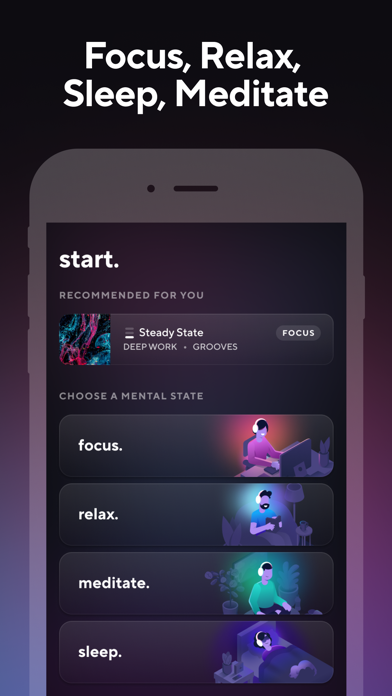
Brain.fm sells a single idea well: music built not to entertain you but to help your brain settle into work. You pick a goal, focus, relax or sleep, press play, and the app generates functional audio meant to nudge you toward concentration within a few minutes. We have leaned on it in open offices and noisy flats, and for a lot of the desk it does what it promises, getting you over the lip into work faster than silence or a normal playlist tends to.
It is also, deliberately, a single lever. There is no task list, no planner, no blocker, no motivation work; just a goal selector, a play button and a session timer. That focus is its strength and its ceiling. Across a busy, fractured month we kept reaching for it as the thing we pressed before starting, but it never pretended to be the system. Think of Brain.fm as the soundtrack to your focus, not the structure that decides what you focus on.
What functional music actually is
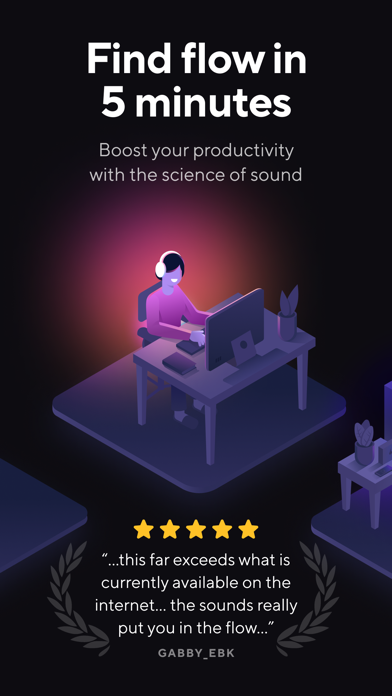
Brain.fm is not a streaming service with a focus playlist. The audio is engineered, using techniques the company groups under auditory entrainment, to encourage a steady, attentive mental state rather than to be enjoyed as songs. The tracks are intentionally unmemorable; nothing hooks you, because a hook would pull attention away from your work.
In practice that means it fades into the background quickly. After a minute or two you stop hearing it as music and it becomes a kind of acoustic scaffolding for the task. Whether that effect is the entrainment doing its job or simply steady, wordless sound masking a distracting room is hard to separate, and honestly, for getting started, it may not matter which it is.
The science, and the honest caveat
Brain.fm leans harder on research than most focus-music apps, and that is a fair claim; there is more published work behind it than behind a generic ambient playlist. For people who want a reason beyond vibes to trust what they are listening to, that backing is part of the appeal, and our own use lined up with the pitch often enough to take it seriously.
The caveat matters, though. Functional-music research is promising rather than settled, and effects vary a lot from person to person. For some it is a reliable on-ramp into flow; for others it is pleasant background and little more. It is not a treatment for anything, and we would not frame it as one. If you have tried it for a couple of weeks and felt nothing, that is a normal outcome, not a failing on your part.
How simple it is to use
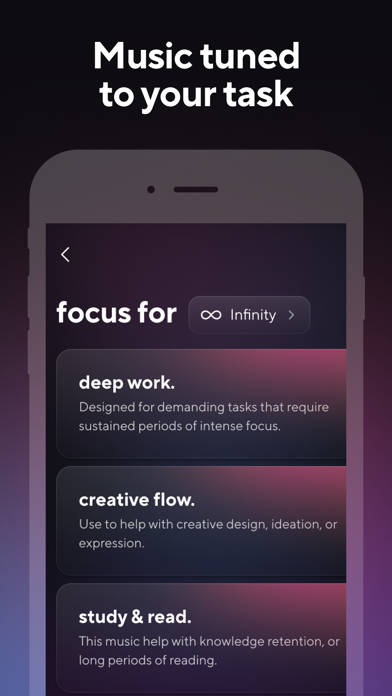
The whole interaction is pick a goal, press play. There are no settings to wrangle, no library to curate, no decisions beyond what you are trying to do right now. You can set a session length so the music runs as a timer of sorts, marking out a focus block, and then it gets out of your way.
That simplicity is a genuine virtue for an anti-procrastination tool, because every extra decision is another place to stall. Brain.fm gives you almost nothing to fiddle with, which means almost nothing to hide behind. For people who focus better with sound, the path from opening the app to actually working is about as short as it gets.
Where it helps most
The clearest wins are environmental. In an open-plan office or a home full of noise, Brain.fm gives you a consistent wall of sound that drowns out the unpredictable interruptions that break concentration. It is also good for the cold start, that moment when you need to drop into a task quickly and a familiar play-this-to-work cue can do a surprising amount of the work.
We found it least useful for tasks that are themselves auditory, like writing that needs an inner voice, where any sound competes. And it does nothing for the deeper problem of not wanting to start at all. Brain.fm helps the willing focus; it does not make the unwilling begin. Match it to noise and momentum problems and it earns its place.
The single-lever limitation
It is worth being blunt about scope. Brain.fm has no task manager, no planner, no habit tracking, no website or app blocking and no reminders to nudge you back. It will happily play perfect focus music while you scroll a distracting site, because it has no idea what you are doing and no tools to intervene.
This is not a flaw so much as a boundary, but it shapes how you should use it. On its own, Brain.fm is one piece of a focus setup. Paired with a way to decide tasks and a way to keep distractions out, it shines. Expected to carry the whole job, it cannot, because pressing play is not the same as doing the work.
Comeback factor: nothing to fail
Brain.fm earns a perfect 5 out of 5 on comeback factor, and the reason is simple: there is nothing to break. No streak, no progress bar, no plant to wither, no character to lose. Disappear for a month and you come back to exactly the same app, with not a trace of guilt baked into the experience.
Because it asks nothing of you between sessions, returning is completely frictionless: open it, pick a goal, press play, as if you never stopped. For anyone who has been put off by apps that punish a lapse, that absence of any failure state is genuinely freeing. It is one of the most forgiving apps in the entire category, alongside the gentlest trackers and timers.
Upfront honesty: the weak point
Here Brain.fm is at its weakest, scoring a 2 out of 5 on upfront honesty. The no-cost path is a short trial and little else; essentially everything beyond it needs a subscription. You get a taste, then a wall. There is no genuinely usable no-cost tier to fall back on, which sits awkwardly for a tool that is, at its heart, audio.
The subscription itself, around 49.99 a year or roughly 9.99 a month, is steep for what it delivers, and you have to commit fairly quickly to keep using it. The trial is enough to tell whether the music works for you, which it should, before you decide. But the short runway and the all-or-nothing structure are the clearest marks against it on our scorecard.
How it compares to Liven
Liven is our top pick at 4.4 out of 5, and it is a much wider tool than Brain.fm. Brain.fm gives you one excellent lever, sound that helps you focus. Liven works on the reasons you struggle to focus at all, the low motivation, avoidance, anxiety and perfectionism, through a guided plan, short psychology courses, a habit builder, mood check-ins, focus soundscapes and an AI coach called Livie. Notably, Liven includes focus soundscapes of its own, so there is some overlap, though Brain.fm goes deeper on the audio specifically.
On our indices the contrast is sharp. Brain.fm is the gentler on comebacks, a perfect 5 against Liven's still-kind 4, because it has nothing to fail. On money the two are level and neither shines: both score a 2 for upfront honesty, with Liven's upsell-heavy onboarding its own openly weak point. One thing both lack: Liven has no Pomodoro timer and no website or app blocker, and Brain.fm has no tasks, planning or blocking either. If sound is the single thing that gets you working, Brain.fm is the specialist. If you want a whole system that happens to include soundscapes, Liven does far more around the music.
Maker: Brain.fm · Platforms: iOS, Android, Web · Approach: Self-guided · Methods: functional music, auditory entrainment
Brain.fm plans & pricing
Free tier: A short a no-cost trial; then subscription.
Trial: A trial offered.
Prices approximate, as of June 2026 — verify on the App Store / Google Play / the app's site. Essentially everything beyond the trial needs a subscription.
Cancellation: Cancel via your app-store subscription or account.
Feature checklist
- Focus / Pomodoro timerSession timer
- Website blocking—
- App blocking—
- Scheduled focus / lock modes—
- Tasks & to-do lists—
- Day / calendar planner—
- Habit & routine builder—
- Focus sounds / musicYes
- Gamification / rewards—
- Accountability / coworking—
- Time tracking & reports—
- Reminders & nudges—
- Guided plan / courses—
- AI coach / chat—
- Progress insightsMinimal
- Cross-device syncYes
Brain.fm pros & cons
What's good
- Genuinely helps many people drop into focus fast
- Backed by more research than most focus-music apps
- Simple — pick a goal, press play
What to weigh up
- Does nothing about tasks, planning or blocking
- Subscription is steep for what is, at heart, audio
Support
Help centre and email.
Method & credibility
Functional-music research; promising but not a treatment, and effects vary by person.
Privacy & data
Standard account/usage data; review the policy.
Third-party ratings
- 4.6 / 5 on App Store — as of June 2026, verify
- 4.2 / 5 on Google Play — as of June 2026, verify
We report independent ratings with their source and date and never invent them. Figures here are approximate and pending verification before launch.
Our data: Brain.fm
Two numbers we measure ourselves, on the same 1–5 scale for every app — the things most roundups never score (see all 20 on the compare page):
Brain.fm FAQ
Is Brain.fm free?
Only briefly. There is a short no-cost trial, after which essentially everything requires a subscription, around 49.99 a year or roughly 9.99 a month. There is no lasting no-cost tier, which is the main reason it scores low for upfront honesty on our scorecard. The trial is enough to test whether the music works for you.
Does Brain.fm actually help you focus?
For many people, yes, especially as a quick way into work or to mask a noisy room. It leans on more research than most focus-music apps, but effects vary a lot from person to person, and it is not a treatment for anything. If a fortnight of use does nothing for you, that is a normal result rather than a failing.
Can Brain.fm block distractions or manage tasks?
No. It is purely functional music with a session timer. There is no task manager, no planner, no habit tracking and no website or app blocking. It will keep playing while you drift to a distracting site, so it works best paired with a separate tool that handles tasks and distractions.