
Habitica Review: 2026 Overview
The verdict
3.8/ 5 Turns your tasks and habits into a role-playing game, complete with a party that holds you to it.
Habitica is the most fun way to build habits if rewards and a bit of peer pressure light you up: your to-dos become an RPG, and your party notices when you slack. It can tip into busywork, and there's no blocker or timer — but as a near-no-cost motivation engine it's one of a kind.
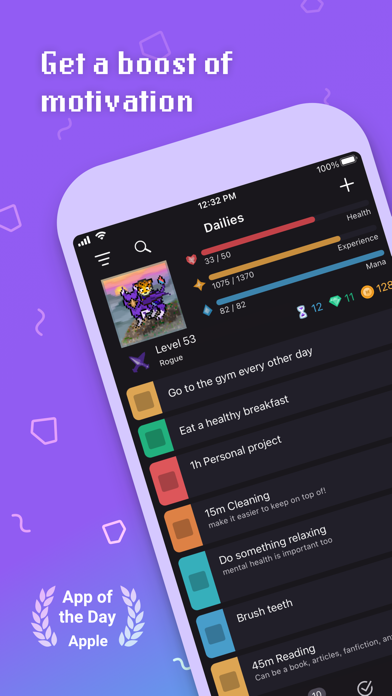
Habitica takes the dullest part of your life, the chores you keep putting off, and reskins it as a role-playing game. Tick a task and your avatar earns experience and gold; skip a daily and you take damage. Add a party of other players and the stakes rise, because when you slack your whole group can lose health. We came to it sceptical that a cartoon health bar could shift real behaviour, and left convinced it does, for the right person, in the right mood.
What it will not do is hide the work. There is no timer to run, no site to block, no plan that tells you why you have been avoiding the report for a week. Habitica is a motivation layer bolted onto a task list, and its whole bet is that the right reward and a watching party will get you to start. Over a busy, badly-timed month we tracked which apps we still reached for once the novelty wore off, and Habitica held on better than its dated screens suggest, though not without sharp edges.
What Habitica is actually for
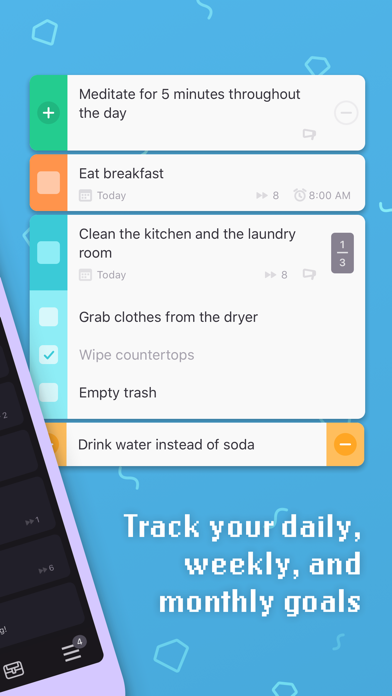
Strip away the pixel art and Habitica is three lists in a coat. Habits are things you do repeatedly with no fixed schedule. Dailies are commitments tied to days of the week, the ones that punish you for missing them. To-dos are the one-off tasks you knock out and never see again. Every completed item pays out experience and gold; every missed daily costs you health.
The genius, and the risk, is that this turns admin into a feedback loop. You start doing things partly because you want to watch the numbers climb. For people who are motivated by games and visible reward, that loop is genuinely effective. For people who find game systems a chore, it adds a layer of bookkeeping on top of the bookkeeping they already avoid.
The first week of setup
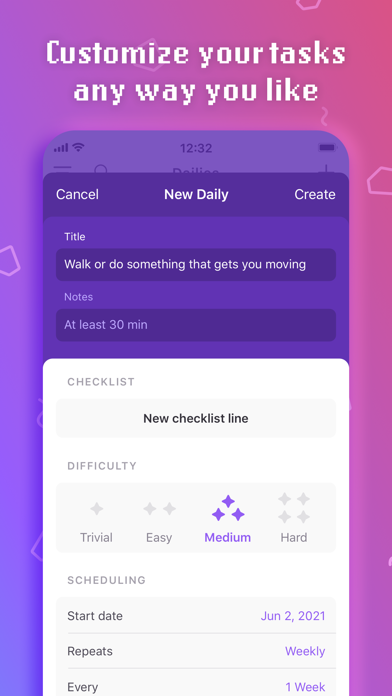
Habitica asks more of you up front than most apps here. You have to decide what counts as a habit versus a daily, set difficulty levels that change the rewards, and resist the urge to log every micro-action as its own task. By the third evening we had over-engineered our list and had to prune it back, which is a common trap. The app does not guide you through this; it hands you the toolkit and lets you build.
Once the structure settled, the daily rhythm was quick: open the app, tick what you have done, watch the rewards land. The friction is all in the configuration, not the use. If you enjoy that kind of tinkering you will be at home; if you want something that works out of the box, the setup will test your patience before the game rewards it.
The party, and why it works
Solo, Habitica is a pleasant points engine. In a party it becomes accountability with teeth. Parties can take on Quests, shared challenges where the group fights a boss, and the boss takes damage when members complete their dailies and deals damage back when they miss. Suddenly your unfinished tasks are not just your problem; they cost your teammates health too.
That social pressure is the strongest thing Habitica has. We found it most useful with a small group of people we actually knew, where letting the side down felt real; with strangers the effect was weaker but still present. If group accountability is what gets you moving, this is one of very few apps that builds it into the core rather than bolting it on.
When the game becomes the procrastination
Here is the honest catch. Habitica is fun, and fun is a double-edged thing for an app meant to stop you avoiding work. We caught ourselves fiddling with avatar gear, reorganising the task list and browsing the marketplace instead of doing the task that earned the gold in the first place. The reward system can quietly become its own distraction.
It is also possible to game your own game. Mark a daily done that you did not really do and the numbers still go up, but the habit does not form. Habitica works best when you treat the points as a side effect of real work, not the goal. That requires a bit of self-honesty the app cannot enforce for you.
Comeback factor: the unforgiving part
This is where Habitica scores worst on our scorecard. Its comeback factor is a 1 out of 5, the lowest we give. Miss a few days and the punishment is built in: your dailies pile up, your avatar takes accumulated damage, and you can log back in to find your character has lost health or even died. After a bad week, the app greets you with a deficit rather than a clean slate.
For some players that sting is the point and it pulls them back. For most people we watched, returning to a pile of overdue dailies after a rough patch felt like a reason to quit rather than restart. There are workarounds, like the rest-at-the-inn feature that pauses damage, but you have to know to use them before you fall off. An app that should welcome you back instead makes you pay for the absence.
Upfront honesty: refreshingly clean
If comeback factor is Habitica's weakness, upfront honesty is its standout, scoring a full 5 out of 5. The entire core game is usable without paying. The whole loop, habits, dailies, to-dos, parties and quests, costs nothing. There is no upsell wall thrown up before the app does anything for you, which is rarer than it should be in this category.
The optional subscription, around 47.99 a year or roughly 4.99 a month, buys cosmetics, gems and quality-of-life perks. It is support for the project rather than a paywall on the function. You can use Habitica for years and never feel pushed. That clarity about money is something we wish more apps here matched, and it is one of the cleanest no-cost stories on our list.
How it compares to Liven
Liven is our top pick, scoring 4.4 out of 5, and it solves a different problem from Habitica. Where Habitica gamifies the doing, Liven works on the why: the low motivation, avoidance, anxiety and perfectionism underneath the procrastination. It pairs a guided plan with short psychology courses, a habit builder, mood check-ins, focus soundscapes and an AI coach called Livie. Habitica treats the symptom with rewards; Liven goes after the cause.
The two also sit at opposite ends of our indices. Habitica is the more upfront on money by a clear margin, its 5 against Liven's openly weak 2, where an upsell-heavy onboarding is the obvious blemish. But Liven is far gentler on the way back, a 4 against Habitica's punishing 1. Neither is a blocker or a Pomodoro timer; Liven lacks both, just as Habitica does. If a watching party and a points engine are what move you, Habitica is hard to beat for the price. If your avoidance has roots you want to understand, Liven is the more complete tool.
Who should use it
Habitica suits people who light up at games and rewards, who want a bit of peer pressure, and who are trying to build several habits at once rather than fix one big avoidance. It rewards the playful and the slightly competitive. It works best when you have at least one party member you genuinely care about disappointing.
It is a poor fit if you want to time your work, block a distracting site, or be talked through why you keep stalling. A reminder on the clinical side: persistent avoidance can tie to ADHD, anxiety or depression, and a game is a tool, not treatment. If procrastination is making your life unmanageable, speak to a professional rather than relying on a health bar.
Maker: HabitRPG, Inc. · Platforms: iOS, Android, Web · Approach: Self-guided, gamified + social · Methods: gamification, habit loops, accountability
Habitica plans & pricing
Free tier: Largely usable without paying — the core game is no-cost.
Trial: n/a (no-cost core).
Prices approximate, as of June 2026 — verify on the App Store / Google Play / the app's site. Subscription adds cosmetics, gems and perks; it's support, not a paywall on the core.
Cancellation: Cancel via your app-store subscription; the no-cost game continues.
Feature checklist
- Focus / Pomodoro timer—
- Website blocking—
- App blocking—
- Scheduled focus / lock modes—
- Tasks & to-do listsYes
- Day / calendar planner—
- Habit & routine builderYes
- Focus sounds / music—
- Gamification / rewardsYes
- Accountability / coworkingParties & guilds
- Time tracking & reports—
- Reminders & nudgesYes
- Guided plan / courses—
- AI coach / chat—
- Progress insightsBasic
- Cross-device syncYes
Habitica pros & cons
What's good
- Genuinely fun gamification — XP, gold, gear and a party that punishes you for skipping
- Largely free
- Combines tasks, dailies and habits in one place
What to weigh up
- The game can become the procrastination
- Dated interface; no timer or blocking; setup takes effort
Support
Wiki, community and email.
Method & credibility
Gamification and social accountability; a motivation tool, not treatment.
Privacy & data
Open-source roots; review the policy. Reasonable on our reading.
Third-party ratings
- 4.3 / 5 on App Store — as of June 2026, verify
- 4.2 / 5 on Google Play — as of June 2026, verify
We report independent ratings with their source and date and never invent them. Figures here are approximate and pending verification before launch.
Our data: Habitica
Two numbers we measure ourselves, on the same 1–5 scale for every app — the things most roundups never score (see all 20 on the compare page):
Habitica FAQ
Is Habitica free to use?
Yes, the core game costs nothing. Habits, dailies, to-dos, parties and quests are all available without paying. The optional subscription, around 47.99 a year, only adds cosmetics, gems and perks; it does not paywall the function, which is why it scores top marks for upfront honesty.
Does Habitica have a focus timer or website blocker?
No. Habitica is a gamified habit and task tracker with no Pomodoro timer, no time tracking and no app or website blocking. If you need to time sprints or lock yourself out of distractions, you will have to pair it with another tool or look at an app built for that job.
What happens if I stop using Habitica for a while?
This is its weak spot. Missed dailies accumulate damage and your avatar can lose health or die, so you may return to a pile of overdue tasks and a battered character. The rest-at-the-inn feature pauses the damage if you set it before a break, but the default experience does not make coming back easy.